
How Steel Truck Wheels Are Made: From Coil to Finished Wheel
A steel truck wheel is a rolled rim and a pressed disc joined by one weld. This guide follows the production route station by station and explains what each step decides for the buyer: tyre seating, load rating, runout, corrosion life and traceability.
Two parts, two lines, one weld
The rim carries the tyre; the disc bolts to the hub and carries the load between the two. They are made on separate lines and meet only at assembly. Every step below exists because something measurable — bead-seat diameter, bolt-hole position, weld integrity, coating film — comes out right there or cannot be fixed later.
Both halves start as hot-rolled wheel steel: our rims and discs are made from 380CL / 440CL (CL series per YB/T 4151), supplied as coil. Wheel steel is a dedicated grade family, specified for formability, weldability and — above all — fatigue strength under millions of load cycles; generic structural steel of the same thickness is not. The load rating guide shows how grade and disc thickness set the rating.
| Stage | Operations | What it decides | Buyer's check |
|---|---|---|---|
| Rim line | Coil slitting → ring rolling → flash butt weld → deburr & planish → roll forming → expanding & sizing → valve hole | Tyre seating, air-tightness, rim roundness | Profile standard (GB/T 31961 / ISO 4209-2), weld inspection method |
| Disc line | Blanking → drawing → bolt holes & hand holes → bolt-seat coining & finishing | Load rating, PCD accuracy, nut seating | Disc thickness, steel grade, mounting type (hub- or stud-piloted) |
| Assembly | Disc press-fit into rim → MIG welding → runout check | Offset, weld fatigue life, balance | Runout inspection record, weld procedure under IATF 16949 |
| Finishing | Pretreatment → cathodic e-coat → top coat → marking | Corrosion life, colour, traceability | Coating system (e-coat + top coat, not paint only), salt-spray hours |
| Test & pack | Air-tightness test → sample fatigue test (radial + bending) → palletising | Proof of the stamped rating | Fatigue test report per model (GB/T 5909 / ISO 3894) |
Rim line: from coil to 15° drop-centre profile
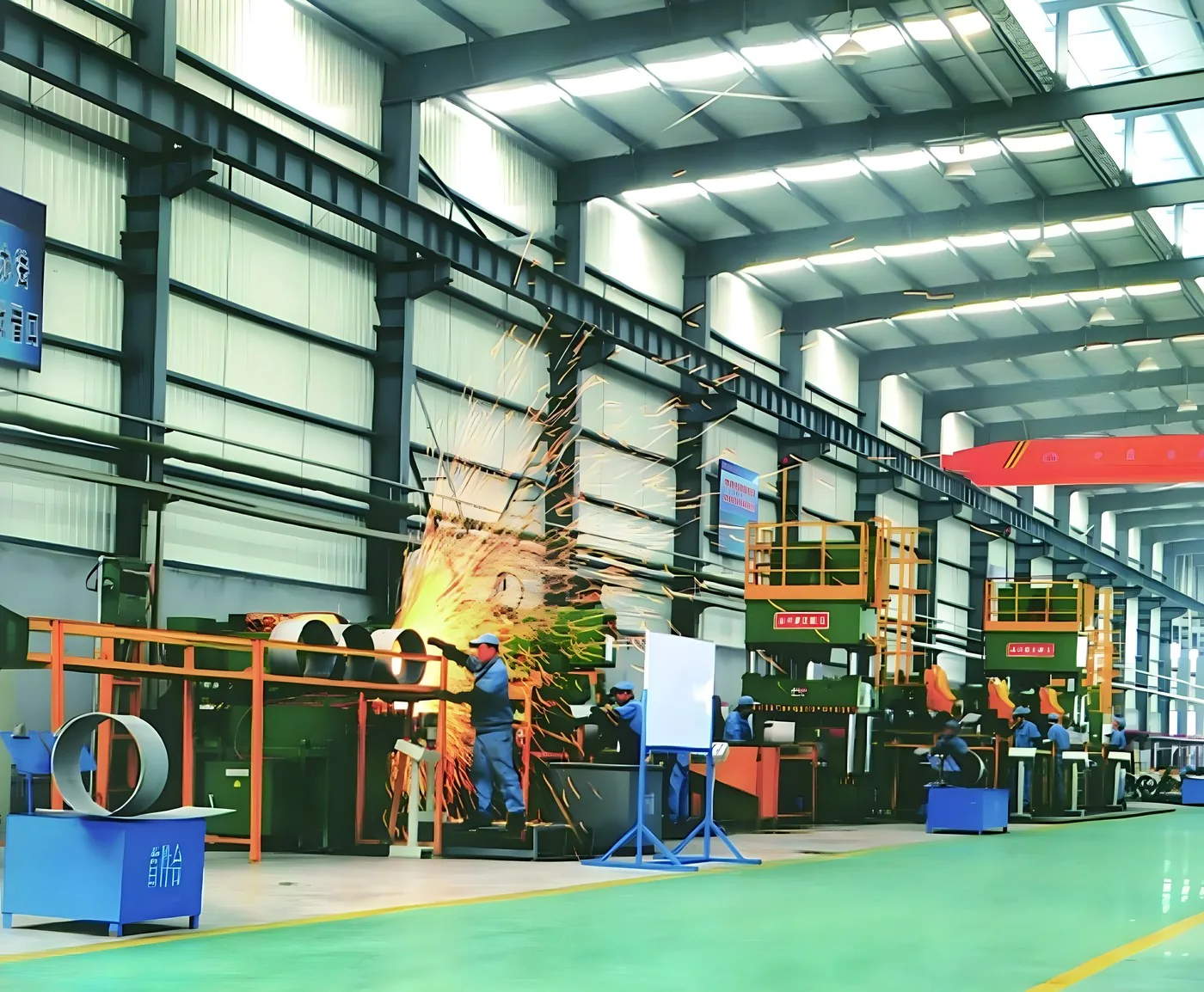
Slitting and ring rolling. The master coil is slit to the developed width of the rim profile, cut to length and rolled into a cylinder with the ends butted. Width accuracy becomes rim width, and edge quality matters: the strip edges become the tyre-bead flanges, and a burred edge is where a flange crack begins.
Flash butt welding. The ends are clamped, heated electrically to forging temperature and pressed together — a solid-state forge weld with no filler, so the seam has the parent strip's strength. It is the one weld that runs across the tyre-bearing surface: the bead must seal over it and the rim carries load through it. Full penetration is not negotiable; ask how it is inspected.
Deburring and planishing. The upset flash is trimmed inside and out and the seam planished flush. The seam crosses the bead seat, so any step is a potential air leak on a tubeless wheel and a stress raiser on any wheel. On a sample it should be almost impossible to find by touch.
Roll forming. The ring passes through several sets of profiled rolls, each pass moving the section closer to the 15° drop-centre (15°DC) profile: two 15° bead seats, two flanges and the mounting well. The taper lets the inflated bead wedge onto the seat and seal without a tube or lock ring.
Expanding and sizing. The formed ring is expanded in a segmented die to its final bead-seat diameter — the dimension the tyre cares most about: too small and it will not seat, too large and it seats loosely. Sizing also makes the rim round, so finished-wheel radial runout is largely decided here.
Valve hole. Punched in the well wall and edge-smoothed so the valve grommet seals; positioned per drawing, away from the weld seam.
Tube-type FB and SDC rims are rolled from a hot-rolled rim section (YB/T 5227) rather than flat coil; the 15°DC route above is the one behind today's 22.5" tubeless sizes.
Disc line: blanking, drawing and the bolt-hole pattern
Blanking. A circular blank is cut from coil at the disc thickness — the largest single lever on load rating, fixed at this moment. Ask for the number on every quotation and check it on the sample.
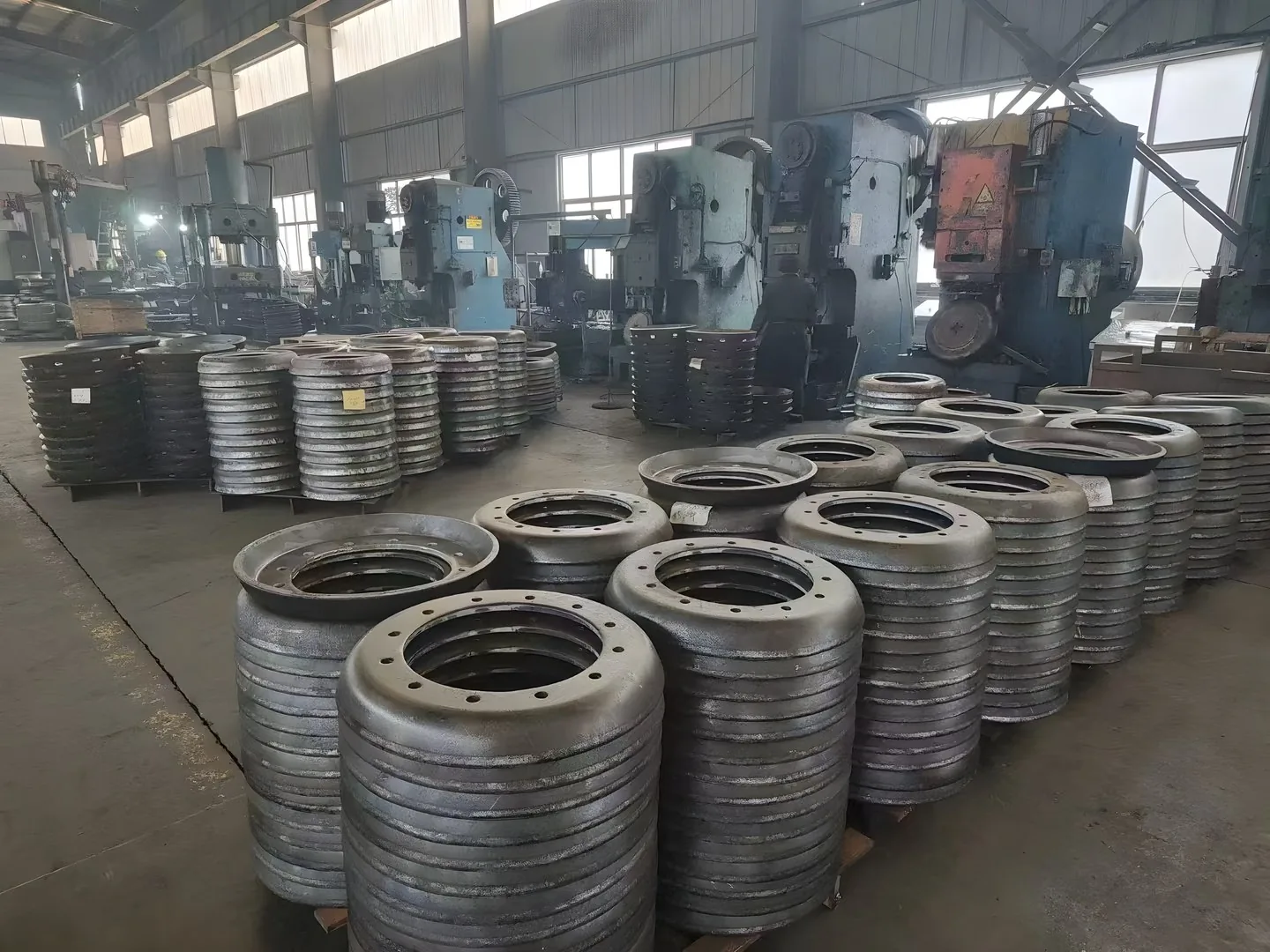
Drawing. The blank is drawn in press dies into the dished disc: flat hub face, conical section and an outer flange that sits inside the rim. The dish gives the disc its stiffness; cold work raises yield strength where the steel is formed. Wrinkles at the cone or necking at the radii are fatigue starting points.
Bolt holes and hand holes. The centre bore, bolt holes and hand holes are punched. Pitch circle and hole diameter must match the hub exactly — the PCD and bolt pattern a buyer specifies. Hand holes give brake cooling and inner-valve access on duals; their edges are dressed because a sharp punched edge under cyclic load is another crack origin.
Bolt-seat coining and finishing. Each bolt hole gets its seat formed — spherical or conical for stud-piloted wheels, flat for hub-piloted wheels with two-piece flange nuts — and hardened by cold work. The seat is where clamping force passes from nut to wheel; a seat of the wrong form loses torque in service. Mounting type is listed per model in the technical catalogue — specify it, do not assume it.
Assembly: press-fit, welding and runout
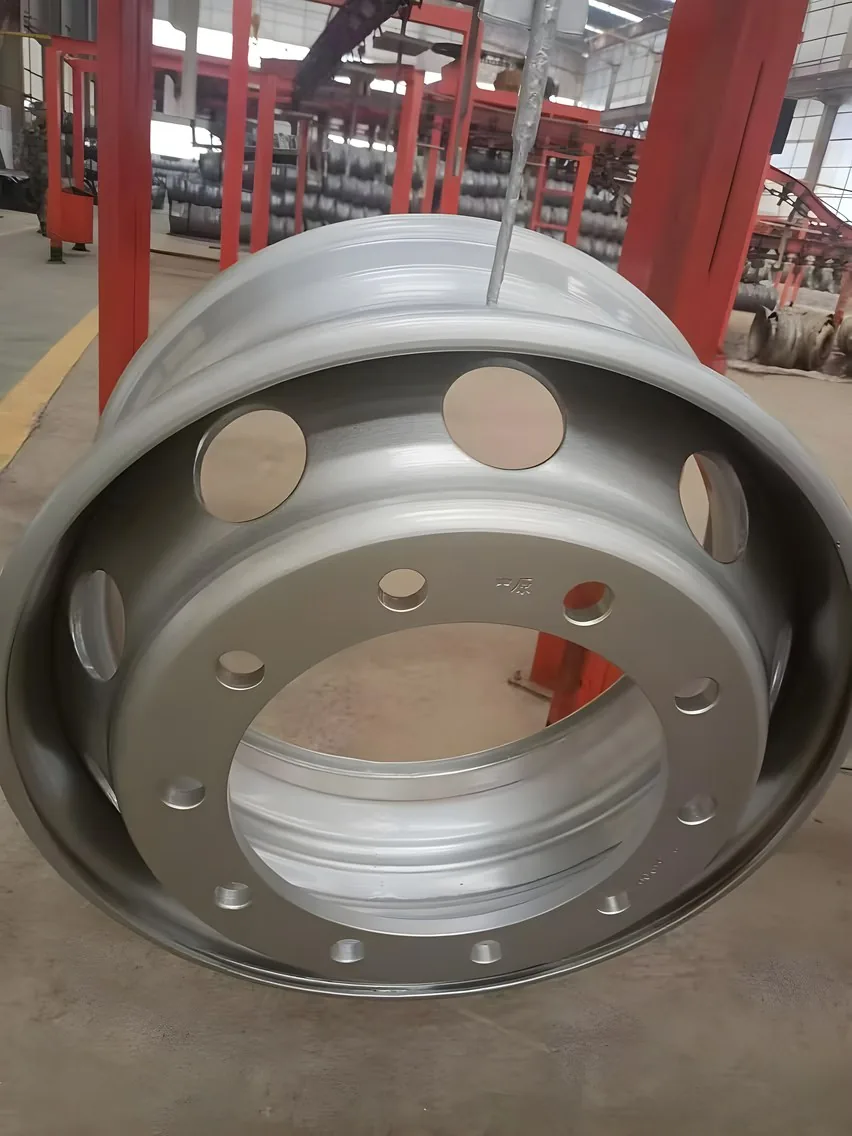
Press-fit. The disc is pressed into the rim with an interference fit, to a controlled depth. That depth sets the offset — the distance from mounting face to rim centreline — and offset sets dual spacing, chassis clearance and hub-bearing loads.
Welding. The disc flange is welded to the rim by MIG/MAG welding, continuous or segmented per the drawing. This joint carries the entire wheel load on every rotation and, with the rim butt weld, is where fatigue cracks start. Controlled welding parameters keep torch angle, travel speed, heat input and weld length identical on the ten-thousandth wheel and the first. Ask for welding procedure records — exactly the process control IATF 16949 audits.
Runout check. The welded wheel is turned on a fixture and radial and lateral runout are measured at the bead seats. Radial runout makes the tyre rise and fall each revolution, lateral runout makes it wobble; both show up as vibration and uneven tyre wear that balance weight cannot fully cure. Out-of-tolerance wheels are reworked or scrapped before coating.
Finishing: pretreatment, e-coat and top coat
Pretreatment. Welds are dressed, the wheel is shot-blasted to remove scale and spatter, then degreased and pickled. A coating is only as durable as the surface under it.
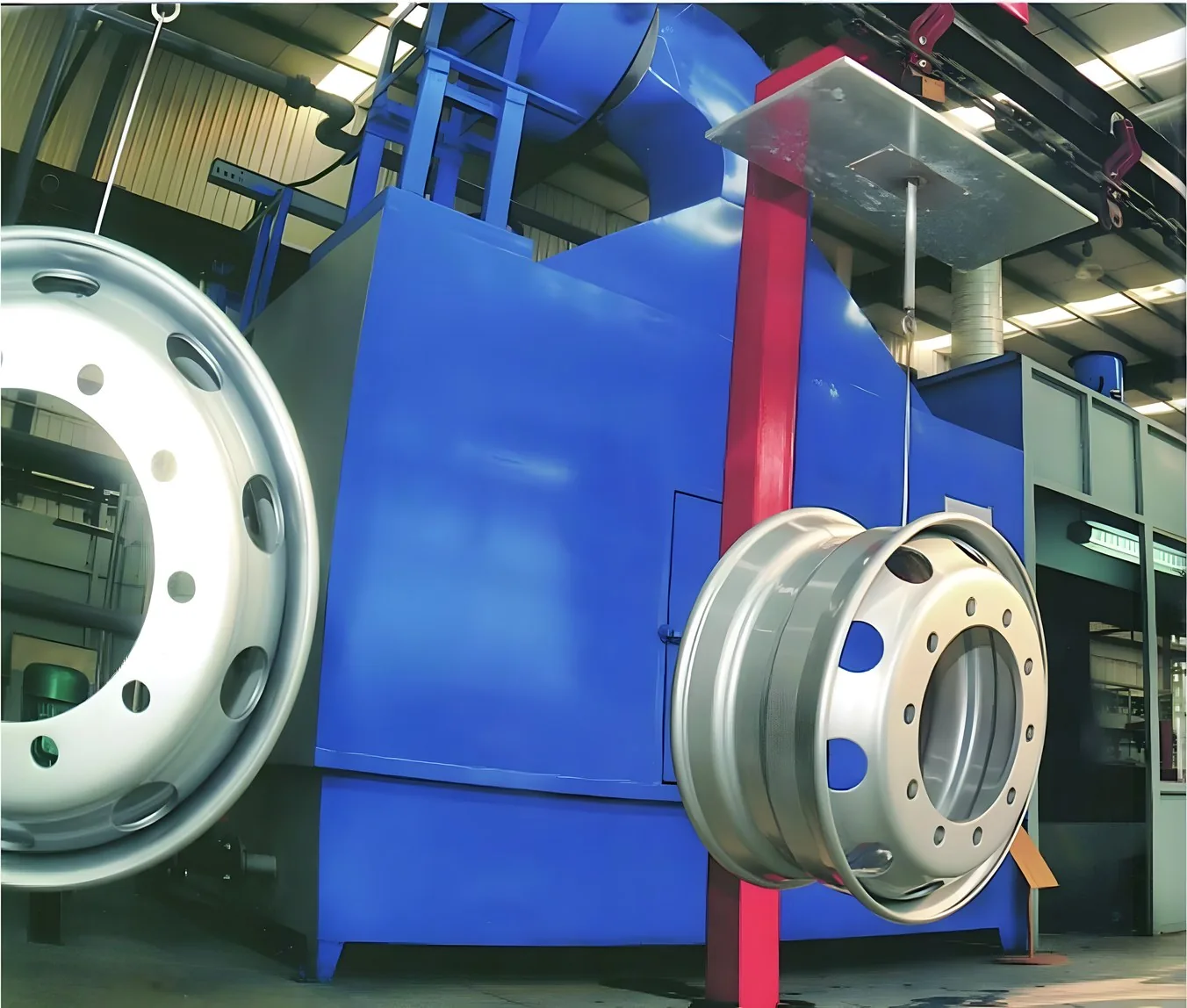
Cathodic e-coat. The wheel is immersed in a waterborne epoxy bath and a direct current deposits the coating onto every wetted surface — hand holes, disc back, weld toes — at a uniform film that spraying cannot match; it is then oven-cured. This layer is the corrosion barrier: salt-spray life is decided mostly by pretreatment plus e-coat, not the colour coat; a wheel that rusts outward from hand holes and weld toes was usually painted without it. Ask for the coating system and the neutral salt-spray hours (ISO 9227 / ASTM B117) it is specified to.
Top coat. A top coat is applied over the e-coat and cured, giving colour, gloss and UV resistance; the e-coat under it keeps the steel dry.
Marking, air-tightness and fatigue testing
Identification marking. Wheels are stamped on the disc with size and traceability marking; the exact marking set (load, date code, brand) is agreed on the order drawing. Traceability marking makes the wheel a traceable batch — steel heat, weld programme and coating run can be pulled for it. No load stamping, no rating.
Air-tightness test. Tubeless wheels are sealed against a test fixture, pressurised and checked for leaks at the butt weld, valve hole and bead seats. A rim that fails here is scrapped rather than found as a slow flat in service.
Fatigue testing by sample. Sample wheels from production are run on test rigs: dynamic radial fatigue, rolling under load against a drum to simulate straight-line running, and cornering (bending) fatigue, where a rotating bending moment simulates a turn — both to the cycle counts and load factors of GB/T 5909 / ISO 3894. This is the test that underwrites the stamped load rating. Our report on file, from a CNAS-accredited laboratory, covers the 22.5×9.00 wheel and is supplied on request.
Palletising and packing. Finished wheels are stacked, strapped and palletised with separators to protect the coating and bead seats; quantity per container depends on wheel size and is confirmed at ordering.
Wheels supplied through Zhongyuan are produced under IATF 16949:2016 — the wheel company's certificate No. 0504999 (manufacturing of steel and aluminum wheels) and the group certificate No. 0599434 — which is what makes the records above auditable. Certificate scans are on Quality & Certificates.
What to ask a wheel factory about its process
- Steel grade and disc thickness, in writing on the quotation.
- Rim weld method and how penetration is verified.
- Disc-to-rim welding — robotic or manual, with procedure records for the model.
- Runout inspection — every wheel or by sample, and to which standard.
- Coating system — cathodic e-coat plus top coat, or paint only — and its salt-spray hours.
- Fatigue test reports for the exact model (radial and bending, GB/T 5909 / ISO 3894) and air-tightness testing of tubeless wheels.
A factory that runs this route can answer all six from records it already keeps. For the finished product this line is built around, see the 22.5×9.00 tubeless steel wheel.
Frequently asked questions
How are steel wheel rims made?
From hot-rolled wheel steel coil: slit to width, rolled into a ring, flash butt welded and planished, roll-formed to the 15° drop-centre profile, sized to final bead-seat diameter and punched for the valve hole — then press-fitted and welded to a pressed disc.
What steel are truck wheels made from?
Dedicated wheel steel, not structural plate. Ours are 380CL / 440CL (CL series per YB/T 4151), selected per model against its load rating and confirmed on the drawing at ordering.
How are steel truck wheels tested before shipment?
In-process dimensional, weld and runout checks; air-tightness testing of tubeless wheels; and sample radial and cornering fatigue tests per GB/T 5909 / ISO 3894; the report on file covers the 22.5×9.00 wheel and is supplied on request.
Tell Us What You Need
Share your drawing, target dimensions or application — our engineers will get back to you with a spec check and quotation.