
22.5×11.75 Tubeless Steel Wheel — Super-Single Trailer Position
The 22.5x11.75 tubeless steel wheel rim carries the 385/65R22.5 wide-base single tyre on trailer axles. Supplied in the ISO 10×335 hub-piloted fitment at zero offset, with a 14 mm disc rated 4,150 kg or a 16 mm disc rated 4,350 kg per wheel. The table below is the configuration we quote; further drillings listed in the group technical catalogue are confirmed on enquiry.
What the 22.5×11.75 is for
An 11.75-inch rim width is the standard rim for the 385/65R22.5 tyre — the super single trailer wheel 22.5x11.75 that replaces a pair of 22.5×8.25 or 22.5×9.00 duals on a trailer axle. One wheel and tyre per hub end instead of two saves weight and rolling resistance, at the cost of losing the second tyre's margin if one fails — which is why the wheel's own rating matters more on a super single than anywhere else on the trailer.
With a single tyre on the hub, offset is kept at zero so that the tyre centreline falls on the hub mounting face and bearing loads stay balanced. The configuration below is zero-offset for exactly that reason.
Configuration and rating
| Bolt holes n×Ø (mm) | Bolt form | P.C.D (mm) | Centre bore (mm) | Offset (mm) | Disc t (mm) | Rated load per wheel (kg) | Std tyre |
|---|---|---|---|---|---|---|---|
| 10×26 | H1 hub-piloted, flat seat (1×45° chamfer) | 335 | 281 | 0 | 14 | 4,150 | 385/65R22.5 |
| 10×26 | H1 hub-piloted, flat seat (1×45° chamfer) | 335 | 281 | 0 | 16 | 4,350 | 385/65R22.5 |
Ratings are the manufacturer's static load ratings. The GB/T 5909 fatigue test report on file (CNAS-accredited laboratory) covers the 22.5×9.00 wheel; no report has been issued for this size. The 385/55R22.5 tyre uses the same rim. An 18 mm reinforced disc, and the 8-stud 275 mm and 120 mm-offset drillings listed in the group catalogue, are quoted on enquiry.
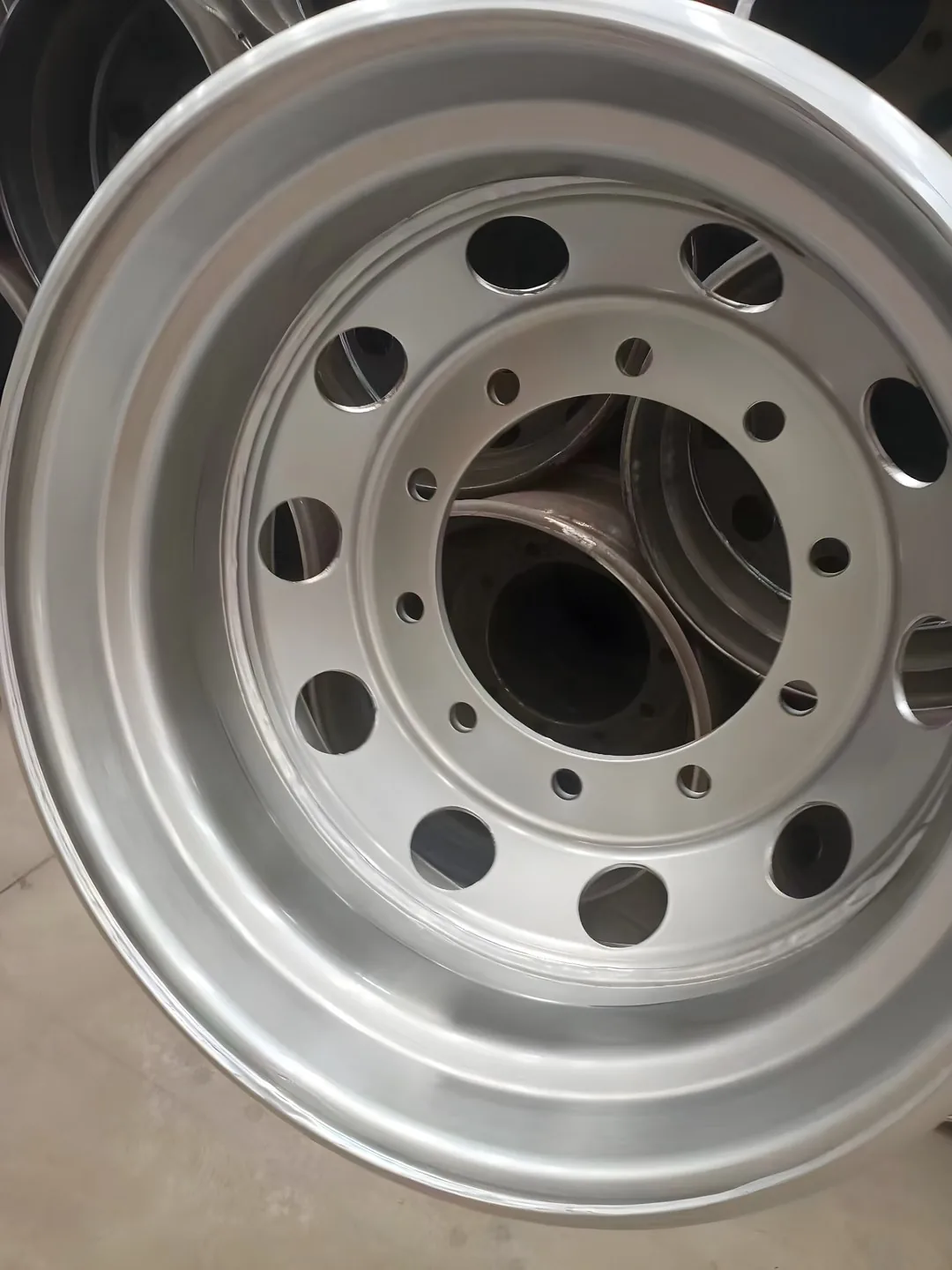
Reading the fitment
Mounting system
- 10×26 H1 hub-piloted — ten Ø26 stud holes on a 335 mm PCD with a 281 mm centre bore: the ISO fitment on European-pattern trailer axles (BPW / SAF type) and current Chinese trailers. The wheel centres on the hub pilots; the flat seats take flange nuts on M22 studs.
- Same pattern as the 10×335 hub-piloted listing on our 22.5×9.00 — the natural super-single partner for fleets running that dual.
- Seat type is the trap — a ball-seat (spherical) nut set will not clamp a flat-seat wheel correctly even when the PCD matches; see the PCD and bolt pattern chart.
Offset and disc
- Offset — 0 mm, the trailer super-single standard.
- Disc thickness — 14 mm (4,150 kg) or 16 mm (4,350 kg): the extra 2 mm of disc is what buys the higher rating.
- Vent holes and valve — hand holes and a single tubeless valve hole per model drawing, issued for approval before production.
Load capacity — size it from the axle
Two wheels per axle on super singles, so the wheel rating must cover half the axle rating: an 8-tonne trailer axle needs at least 4,000 kg per wheel, a 9-tonne axle 4,500 kg. Against those numbers both discs cover an 8-tonne axle — the 14 mm (4,150 kg) with margin, the 16 mm (4,350 kg) with more; neither reaches the 4,500 kg per wheel a 9-tonne axle needs. For 9-tonne axles, or an 8-tonne axle run at full rating on poor roads, ask for the 18 mm reinforced disc, which is quoted on enquiry.
The tyre rating is the other half: a 385/65R22.5 commonly carries load index 160 (4,500 kg single) and reinforced constructions index 164 (5,000 kg). The lower of the wheel rating and the tyre rating governs the corner — on a 14 mm disc, the wheel is that lower figure. Market context: the heaviest European super-single steel wheels are rated up to about 5,200 kg; see load ratings explained.
Disc thickness is the buyer's cross-check: ask for it on every quotation you compare. A wheel quoted markedly lighter at the same claimed rating has lost material, usually in the disc.
Quality and certification
The wheels on this page are manufactured under IATF 16949:2016 — certificate No. 0504999 (manufacturing of steel and aluminum wheels) / group certificate No. 0599434. Certificate copies go out with the quotation and can be verified through the issuing certification body — see our IATF 16949 verification guide. Corrosion protection is pickling followed by cathodic electrophoretic coating; top-coat colour and disc marking are agreed at quotation stage.
What to send for a quotation
- Bolt pattern from the axle drawing — hole count, PCD, centre bore and seat type (ball-seat or hub-piloted); or simply the axle make and model.
- Offset — 0 or 120 mm for the catalogue models; anything else is a custom enquiry.
- Tyre size and load index you intend to fit, so the wheel rating can be checked against it.
- Quantity per configuration and destination port.
- Finish and marking — top-coat colour and any private-label stamping; see OEM & Custom for what can be specified.
- Inspection requirements — pre-shipment inspection or certificate copies required in the shipping documents.
Frequently asked questions
Is 22.5×11.75 the right rim width for a 385/65R22.5 tyre?
Yes. 11.75 inches is the standard rim width for the 385/65R22.5 wide-base single tyre. Some tyre manufacturers also approve a 12.25 rim; check the tyre maker's approved-rim list before pairing the tyre with any other width.
Which fitment do I need — 10×335 or 10×285.75?
This wheel is supplied in the ISO 10×335 hub-piloted fitment (Ø26 holes, 281 mm centre bore, flat seat), which is what European-pattern and current Chinese trailer axles carry. If your axle drawing shows a 285.75 mm bolt circle or a ball-seat nut set, send the drawing — that is a different wheel, and we will confirm what can be offered rather than force a fit.
What load rating does the 22.5×11.75 tubeless steel wheel carry?
4,150 kg per wheel with the 14 mm disc and 4,350 kg with the 16 mm disc, as the manufacturer's static ratings. The GB/T 5909 fatigue test report on file (CNAS-accredited laboratory) covers the 22.5×9.00 wheel; no report has been issued for this size. An 18 mm reinforced disc is quoted on enquiry.
Can I get a different offset, colour or private-label marking?
Non-catalogue offsets, top-coat colours and disc marking are handled as custom items and quoted case by case. The standard configuration is supplied as listed in the table above.
Tell Us What You Need
Share your drawing, target dimensions or application — our engineers will get back to you with a spec check and quotation.